NBA 2K27 MyNBA Team Dynamics, Rule Changes and the New Draft Lottery Explained
NBA 2K27's MyNBA mode got its biggest overhaul in years: a new Rule Change Engine for league-wide voting, a 3-2-1 draft lottery, and a Team Dynamics system that tracks player morale, friendships and grudges. Here's what 2K's official Courtside Report says about League Meetings, Dynamic Duos, Draft Class Playlists and the new Community Requests.
MyNBA, NBA 2K27's franchise mode, picked up its biggest overhaul in years this cycle. 2K's own Courtside Report calls it a "Back to Basics" rebuild, and the headline additions are a new Rule Change Engine for league meetings, a 3-2-1 draft lottery format, and a Team Dynamics system that tracks morale, friendships and rivalries between players on your roster. None of this is a rumor or a leak — it comes straight from 2K's official MyNBA reveal, and the screenshots below are from that same release.
If you're deciding whether to boot up a new MyNBA save, this guide walks through exactly what changed: how the Rule Change Engine votes work, what the new draft and playoff rules actually are, how the morale system turns your locker room into something closer to a soap opera, and where Draft Class Playlists and the Community Requests fit into all of it.
1. The New Rule Change Engine and How League Meetings Work
The centerpiece of the overhaul is an expanded Rule Change Engine. Instead of a short list of toggles buried in a settings menu, MyNBA now runs actual League Meetings where all 30 teams' front offices vote on offseason rule proposals using custom sliders. 2K describes it as letting GMs "explore, review, and vote on an unlimited number of offseason proposals," and in the screenshot 2K released, each proposal needs 23 of 30 votes to pass — a real supermajority, not a rubber stamp.
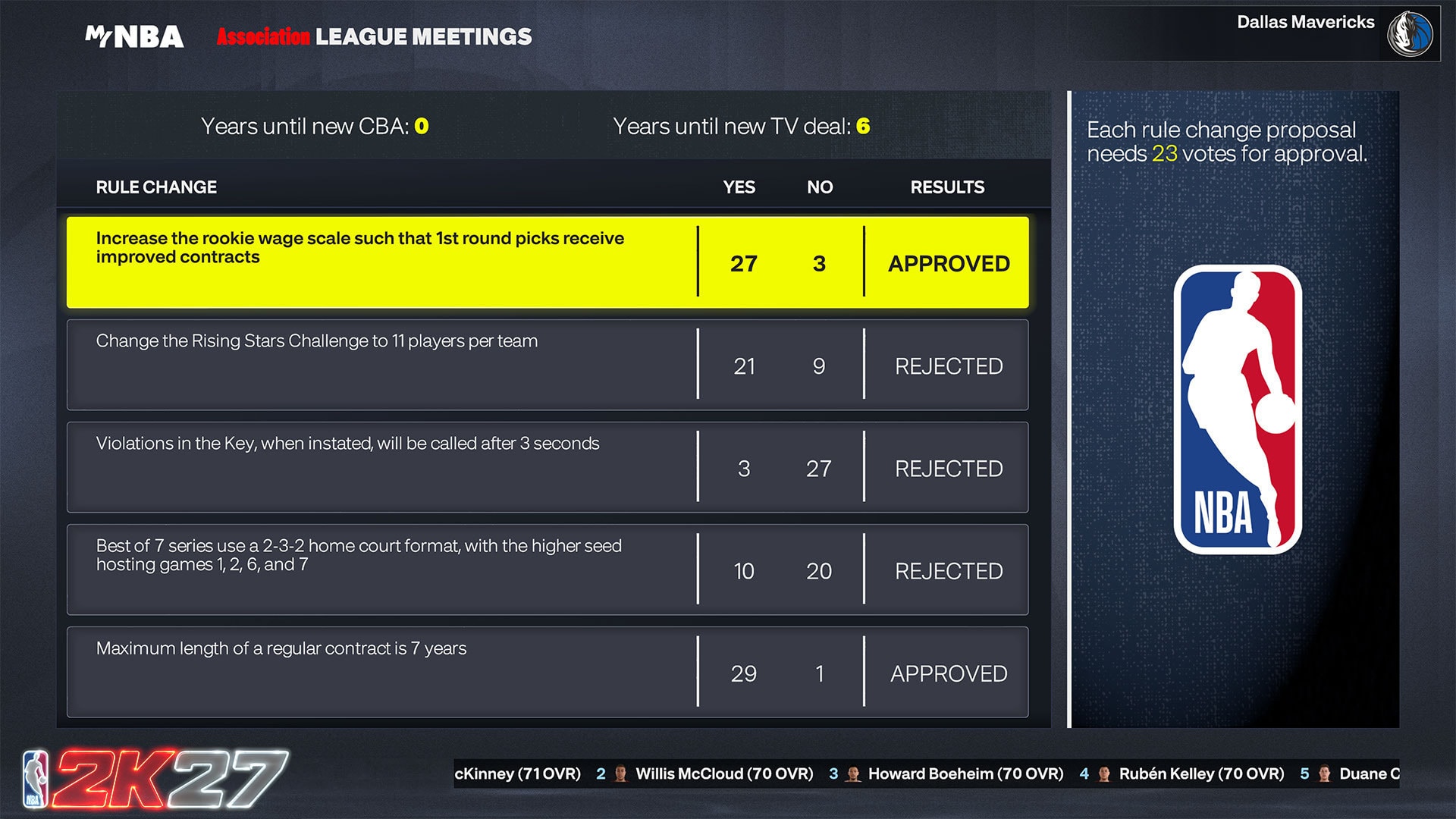
That same screenshot is worth studying because it shows exactly what a real meeting looks like in practice. The five proposals on screen and their results:
- Increase the rookie wage scale so first-round picks get improved contracts — approved, 27–3.
- Change the Rising Stars Challenge to 11 players per team — rejected, 21–9.
- Call Violations in the Key after 3 seconds — rejected, 3–27.
- Use a 2-3-2 home court format for best-of-seven series — rejected, 10–20.
- Cap the maximum length of a regular contract at 7 years — approved, 29–1.
Those aren't hypothetical examples — they're the actual proposals 2K used to demo the system, and they show the kind of granular league-governance decisions MyNBA GMs can now put to a vote every offseason, from roster-building rules down to in-game officiating quirks.
2. The 3-2-1 Draft Lottery, Clutch Player of the Year and New Playoff Formats
Beyond the custom proposals, 2K baked several real rule changes into MyNBA by default to better match how the modern NBA actually runs its business. According to the official MyNBA announcement, this includes a new 3-2-1 draft lottery format, a Clutch Player of the Year award, and new playoff series formats. The NBA Cup now also tracks appearances in player and staff career histories and supports variant host cities, and MyNBA reflects modern All-Star Weekend formats as well.
2K hasn't published a detailed breakdown of how the 3-2-1 lottery weighting or the new playoff series structures work mechanically, so treat those specifics as things to discover in a save rather than numbers to plan around in advance — but the fact that they now exist as rules a league can vote on (rather than being hardcoded) is the actual news here.
3. Team Dynamics: Morale, Friendships and Grudges
The other major system is Team Dynamics, a revamped morale layer that tracks relationships between the players on your roster over time. 2K says it follows friendships, rivalries and personality traits, and that bonds build up from shared history together while grudges can form from repeated postseason exits as a group.
In practice, that means two teammates who've been through a lot together — deep playoff runs, locker-room chemistry, shared accolades — will carry that history into how they perform and how they feel about staying on your team, while a roster that keeps bowing out early can start to resent each other. It's the same instinct behind GM Trust, which you can read about in full in our breakdown of GM Trust, trades and the buyout market — Team Dynamics is the player-to-player version of that same "does this front office/teammate actually mean what they say" idea.
4. Dynamic Duos and Big 3s Explained
When Team Dynamics escalates, it produces named results. Two stars who build up a high enough Friendship rating form what 2K calls a Dynamic Duo. Stack a third elite-friendship star onto that core, and you get a Big 3 — the same kind of player-driven chemistry that's defined real NBA rosters for the last two decades, now modeled as an actual in-game relationship rather than just a vibe.
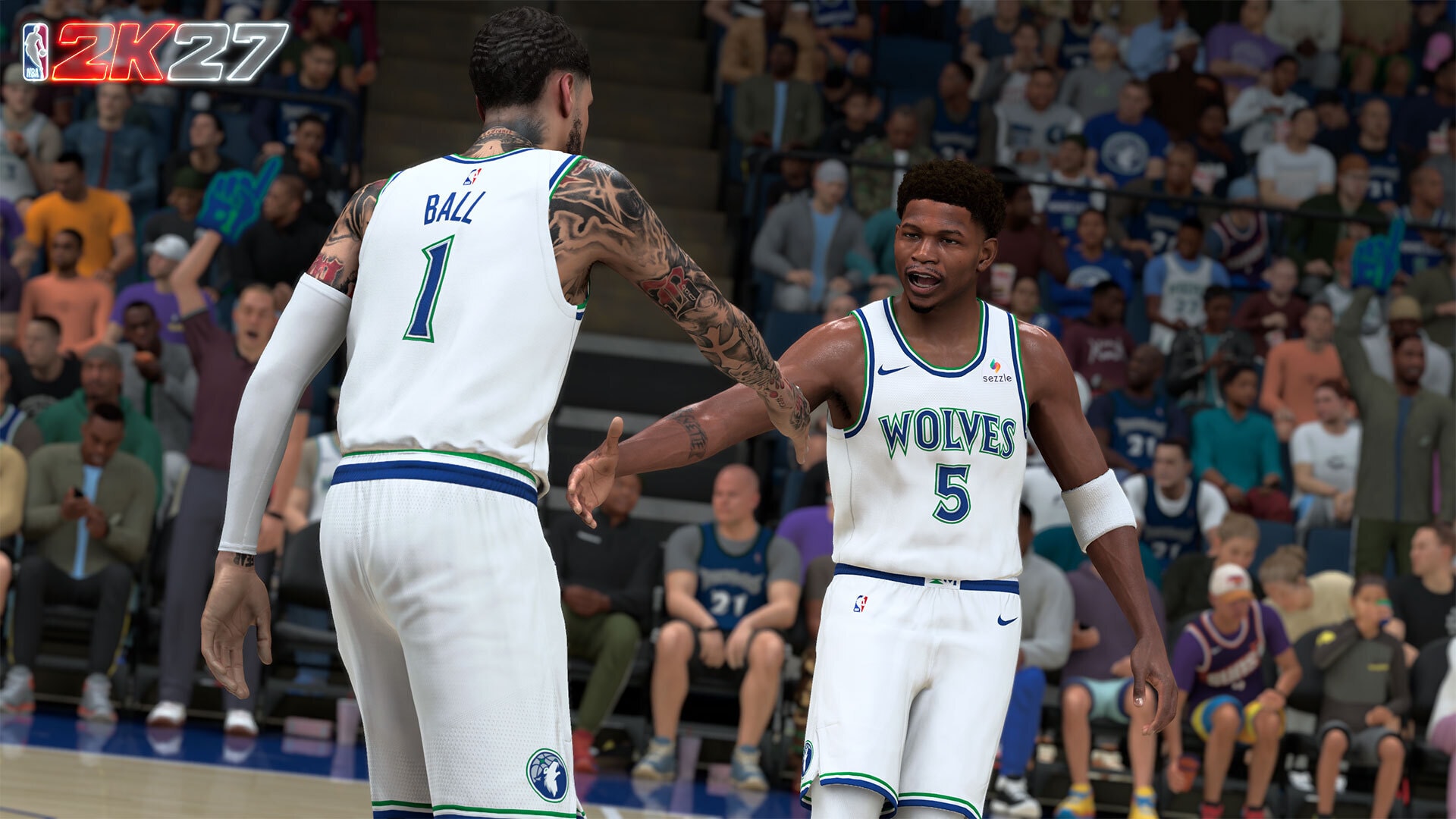
2K hasn't published the exact Friendship thresholds needed to trigger a Dynamic Duo or Big 3 designation, so don't expect a hard number here — but the system is explicitly built to reward keeping a core together over multiple seasons rather than chasing a new superteam every offseason, which lines up with the overall "back to basics" framing of this year's MyNBA update.
5. Draft Class Playlists: Rewriting Basketball History
MyNBA also adds Draft Class Playlists, which let you build a custom run of historic draft classes to cycle through as your league's rookies arrive each year. You pick a start year and an end year, and the game will queue up those real draft classes in order — 2K's own screenshot shows a playlist running from 1986 through 2021.
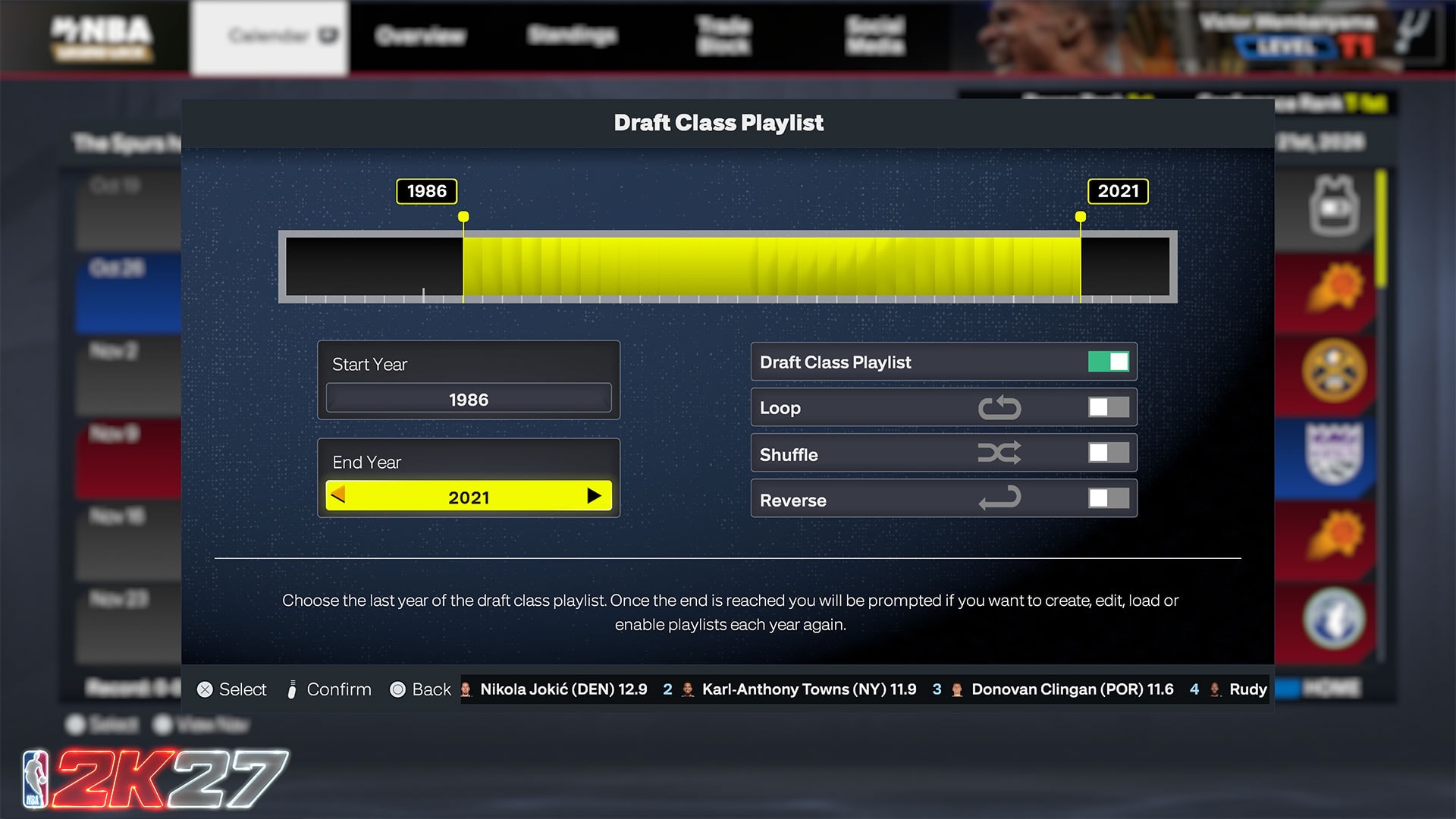
Three toggles control how the playlist behaves: Loop sends it back to the start year once it reaches the end, Shuffle randomizes the order classes arrive in, and Reverse runs it backward. Combine them and you can build something like an alternate-reality league where, say, the 2021 class (headlined in 2K's own example by names like Nikola Jokić, Karl-Anthony Towns and Donovan Clingan) shows up on a random year instead of its real one. Once a playlist reaches its last year, the game prompts you to create, edit, load or re-enable a playlist for the next cycle, so it's meant to be revisited rather than a one-time setup.
6. Community Requests: Four-Team Trades, the Buyout Market and Eurostash Contracts
2K frames a big chunk of this update as direct responses to community feedback, bundled under more than 20 roster-control and league-management changes. The headline additions:
- Four-team trades are now supported, with a nine-asset cap per trade and the ability to include cash considerations.
- Contract buyouts now run through a dedicated Buyout Market rather than being handled ad hoc.
- Eurostash contracts for internationally-stashed prospects were rebuilt under the hood to behave more realistically.
On the contract side, MyNBA's CBA simulation also got closer to the real thing: a new free agency menu during the Moratorium Period lets you pitch marquee free agents with promises that are actually binding on roster moves, incentives and loyalty, performance incentives are graded as Guaranteed, Likely or Unlikely, and Second Apron trade restrictions plus limited 10-day contracts now apply across both the NBA and the WNBA side of the mode. If you want the deep dive on exactly how GM Trust interacts with those contract tools, the GM Trust and buyout market guide covers that side in detail.
7. Where This Fits Alongside MyNBA Legacy
All of this — the Rule Change Engine, the draft and playoff format changes, Team Dynamics, Draft Class Playlists and the Community Requests — sits underneath MyNBA Legacy, the mode's new player-locked, 100-year dynasty RPG layer. Legacy lets you lock onto a Legend, keep playing as their descendants across generations, and chase "Eternal G.O.A.T. status" by stacking Performance Points from stat goals and deep playoff runs.
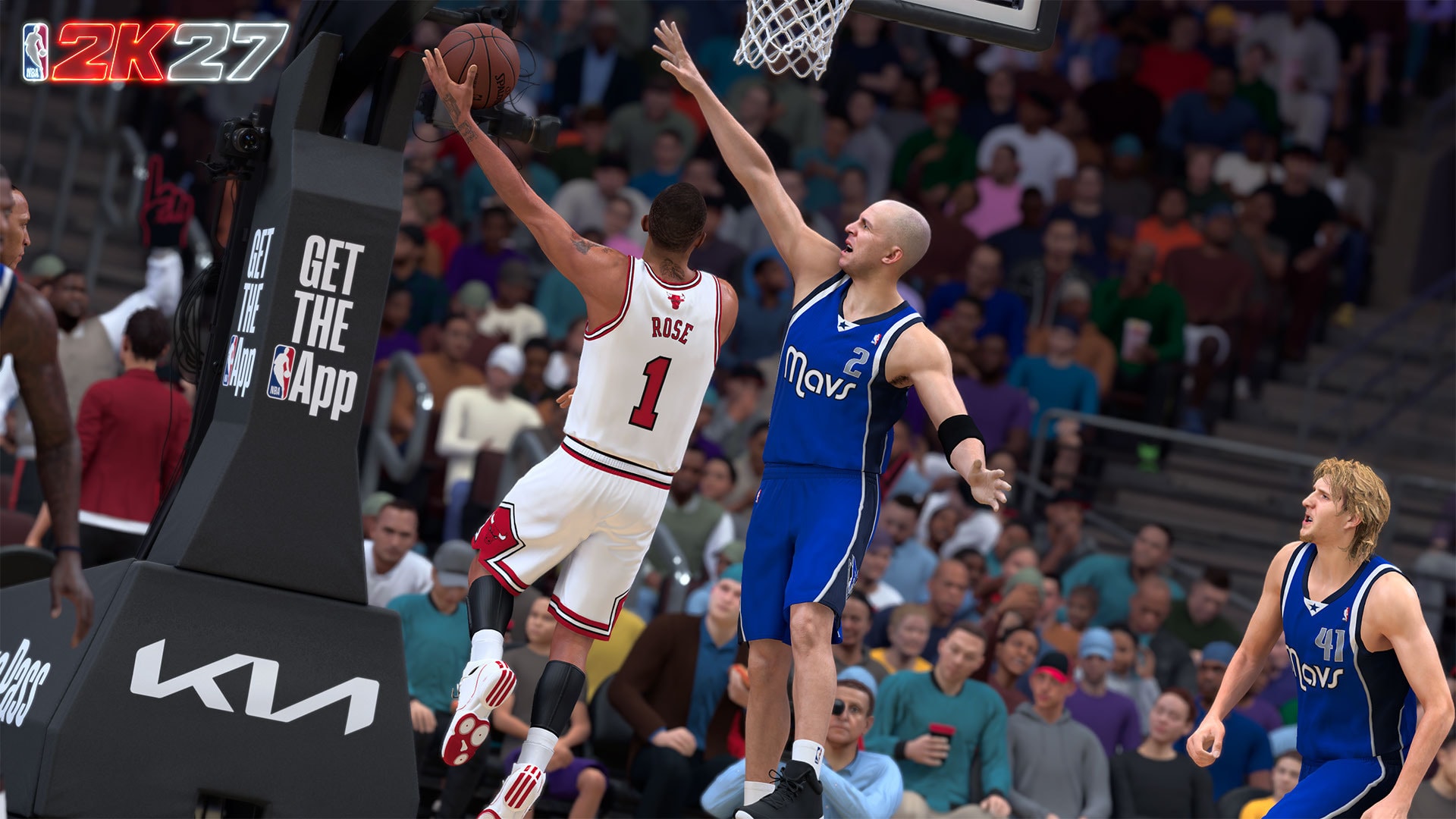
In other words, Team Dynamics isn't just flavor text — a Dynamic Duo or Big 3 you build up over several seasons can directly feed into how your Legacy dynasty's descendants inherit traits, since 2K says descendants pick up hereditary bonuses from their parent's rookie profile. If you haven't read up on how the century-spanning side of Legacy actually works, our full breakdown of the 100-year dynasty covers that half of the system.
Quick-tips recap
- League Meetings now need a real 23-of-30 supermajority to pass a rule change — don't expect every proposal you like to go through.
- Team Dynamics tracks morale, friendships and grudges; keeping a winning core together builds toward a Dynamic Duo or Big 3 instead of forcing one through trades.
- Draft Class Playlists let you set a start/end year range and Loop, Shuffle or Reverse the order real draft classes arrive in.
- Four-team trades (nine-asset cap, cash allowed), a dedicated Buyout Market, and rebuilt Eurostash contracts are new community-requested tools.
- Second Apron trade restrictions and limited 10-day contracts now apply in both the NBA and the WNBA side of MyNBA.
Official Resources
- NBA 2K27 MyNBA feature overview — nba.2k.com
- 2K's official MyNBA Courtside Report announcement — newsroom.2k.com
- 2K official site
For everything else new this cycle, including MyPLAYER builds and The City, see the full MyCAREER and MyPLAYER Builder guide, or browse every NBA 2K27 piece we've published so far on the walkthroughs archive.